
Yellow Jacket Nest in the Ground? Do This, Not That
Discovered a yellow jacket nest in ground on your lawn? Avoid gasoline burns and secure pressurized dust removal. Call (321) 496-4080 quickly.
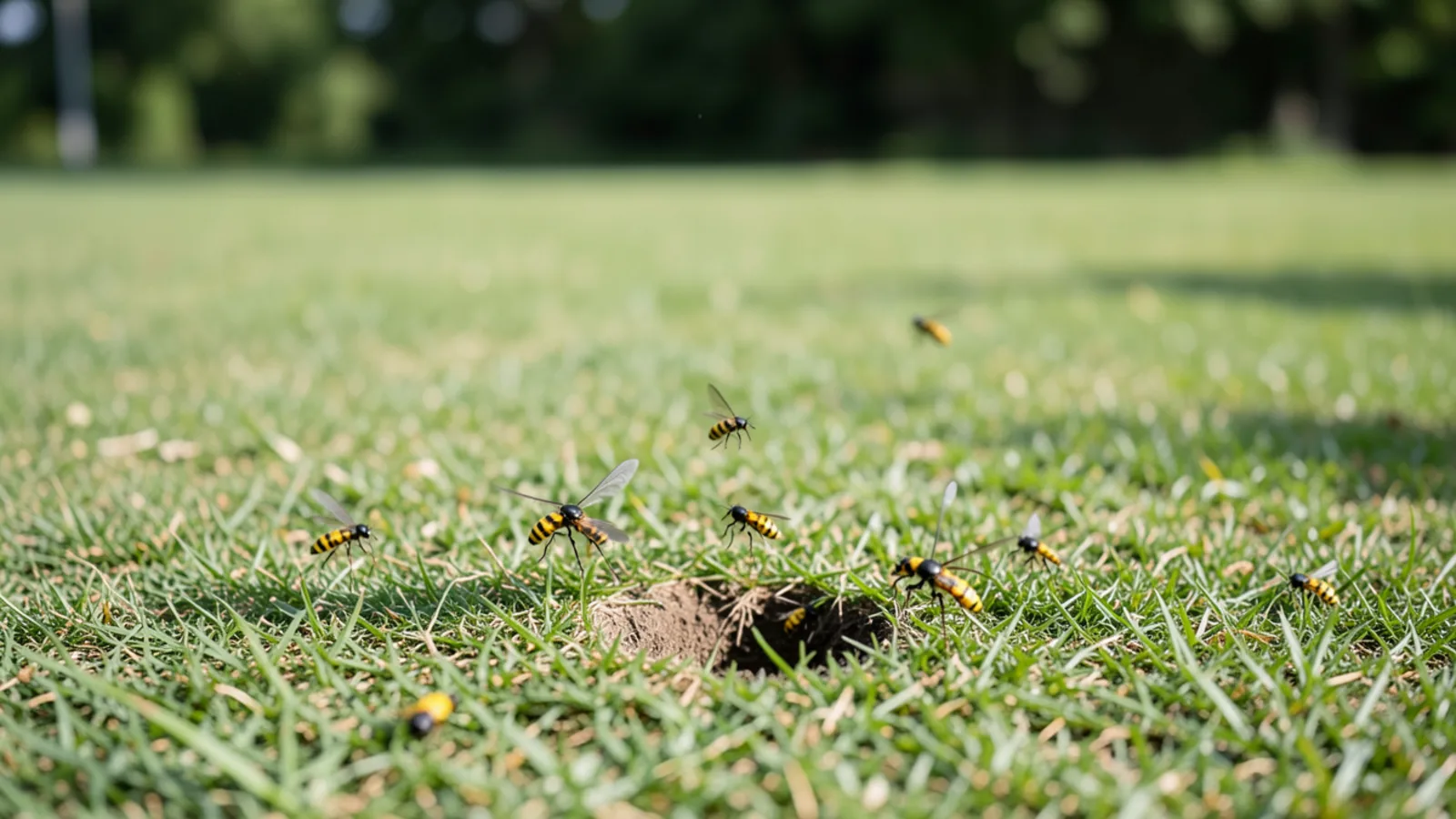
If you find a yellow jacket nest in the ground, mark the entrance from a safe distance, keep children and pets indoors, and never pour gasoline, bleach, or boiling water into the hole. Subterranean nests house thousands of aggressive wasps that sting repeatedly; eliminate them safely by applying specialized insecticidal dust directly into the burrow entrance at night or calling a licensed exterminator.
From mid-summer through late October, routine lawn mowing and yard maintenance across Midlothian, Chester, and Chesterfield County frequently turns perilous when homeowners encounter ground-nesting eastern yellow jackets (*Vespula maculifrons*).
Unlike aerial paper wasps that build visible umbrella combs beneath roof gutters, yellow jackets frequently take over abandoned rodent burrows, hollow tree root depressions, or flowerbed mulch beds. The subterranean entrance is often no larger than a nickel, completely concealed by turf grass until lawnmower vibrations trigger an instantaneous, coordinated swarm attack.
Because yellow jackets can sting repeatedly without losing their stingers, stepping on an active colony frequently results in dozens of painful stings within seconds. Knowing what to do—and what dangerous DIY folklore to avoid—is vital for your family's safety.
Critical "Do Nots" for Underground Yellow Jacket Nests When dealing with an active ground nest, emotional reactions often lead to dangerous DIY experiments that worsen the hazard:
- 1. **Do NOT Pour Gasoline or Kerosene Down the Hole:** Pouring flammable fuels into an underground nest is an illegal, environmentally destructive practice that contaminates local soil, damages groundwater, and creates severe flash-fire risks. More importantly, gasoline rarely kills the underground queen; it simply drives hundreds of disoriented, enraged worker wasps out into surrounding turf.
- 2. **Do NOT Pour Boiling Water Down the Burrow:** Subterranean yellow jacket nests feature extensive, winding tunnels that turn horizontally beneath tree roots. Boiling water cools rapidly upon contacting soil, saturating the upper tunnel while leaving the central brood chamber completely unharmed.
- 3. **Do NOT Try to Cover the Hole with a Bowl, Brick, or Flowerpot:** Yellow jackets possess powerful chewing mandibles. If you obstruct their primary entrance, the colony will quickly excavate several new exit tunnels through surrounding sod, creating multiple hidden escape points.
- 4. **Do NOT Approach the Nest During Daylight Hours Without Protective Gear:** Yellow jackets forage actively during the day and have acute vision. Approaching within 10 feet in standard clothing guarantees a defensive swarm attack.
Safety Protocol: What to Do If You Stumble on a Nest - **Cover Your Face and Run in a Straight Line:** If you disturb a ground nest, do not swat or flail your arms, which releases alarm pheromones that attract more wasps. Cover your face with your hands and run straight toward an enclosed structure or vehicle. - **Mark the Location from a Safe Distance:** Once indoors, observe the area from a window to note the exact entrance hole in the lawn, noting nearby landscape landmarks (such as a tree, hose reel, or fence post). - **Keep Children and Pets Indoors:** Erect temporary caution markers or keep dogs leashed when using the backyard. - **Seek Immediate Medical Attention for Severe Reactions:** Yellow jacket stings can trigger systemic anaphylaxis. If you experience difficulty breathing, throat tightness, dizziness, or widespread hives, administer an epinephrine auto-injector if prescribed and call 911 immediately.
DIY vs. Professional Ground Nest Eradication
| Eradication Method | How It Works | Danger Level | Colony Elimination Rate |
|---|---|---|---|
| **Retail Aerosol Spray Cans** | Shoots stream of liquid pyrethroid | Very High (limited reach; triggers swarming) | Under 30% (liquid cannot penetrate deep turns) |
| **Gasoline / Bleach Flooding** | Dousing hole with toxic flammable liquids | Extreme (environmental crime, fire hazard) | Low; scatters angry colony across lawn |
| **Nighttime Insecticidal Dusting** | Injecting micro-fine powder into active burrow | Safe when executed in commercial sting suit | **100% complete colony elimination** |
| **Physical Nest Digging** | Shoveling out underground paper comb | Extreme (guarantees massive swarm stings) | High, but accompanied by emergency hospital visits |
Expert Insight: Underground Nest Architecture, Venom & Honeybee Protection To understand why standard aerosol sprays fail against ground yellow jackets, one must examine the physical subterranean architecture of *Vespula maculifrons*. When yellow jackets commandeer an abandoned chipmunk or field mouse tunnel, they do not build their comb at the surface entrance. The entry tunnel extends downward six to twelve inches before taking a sharp horizontal turn beneath tree roots or foundation footings, opening into an excavated subterranean cavern that can reach the size of a basketball.
Liquid spray shot from an aerosol can strikes the first dirt bend and puddles uselessly in the topsoil, completely failing to contact the brood comb below. The liquid vapor simply agitates the subterranean guard wasps, prompting thousands of defensive insects to boil out of secondary exit tunnels.
Yellow jacket venom contains potent biochemical compounds—including melittin, apamin, and phospholipase enzymes—that directly cause cellular breakdown and intense pain. Unlike honeybees (*Apis mellifera*), whose barbed stingers pull loose from their abdomen during a sting, yellow jackets possess smooth lancet-like stingers that can inject venom multiple times consecutively without causing death to the wasp.
Furthermore, environmental responsibility requires careful species distinction. Honeybees frequently swarm in spring and nest in hollow tree trunks; because honeybees are critical agricultural pollinators, Sayonara Pest Control collaborates with local beekeeping associations (such as the Richmond Beekeepers Association) to arrange live extractions for true honeybees. However, aggressive subterranean yellow jackets nesting in high-traffic lawn areas pose an immediate human safety hazard that demands swift, lethal eradication.
Underground Nest Architecture & Seasonal Population Cycles Understanding yellow jacket colony dynamics explains why these underground nests are so dangerous. In April, a single fertilized queen emerges from winter hibernation under loose bark and finds an abandoned mouse burrow. She excavates a small chamber and rears her first generation of 10 to 20 sterile female workers.
By July and August, those workers take over all foraging and excavation duties, expanding the underground cavern into a multi-tiered paper comb structure surrounded by a protective paper envelope. By September, a single subterranean nest in a Midlothian lawn can house between 2,000 and 4,000 active adult wasps. Guard wasps stationed at the burrow entrance detect ground vibrations from footsteps or lawnmower engines from up to 20 feet away, releasing volatile alarm pheromones that instantly alert hundreds of aggressive defenders to attack the source.
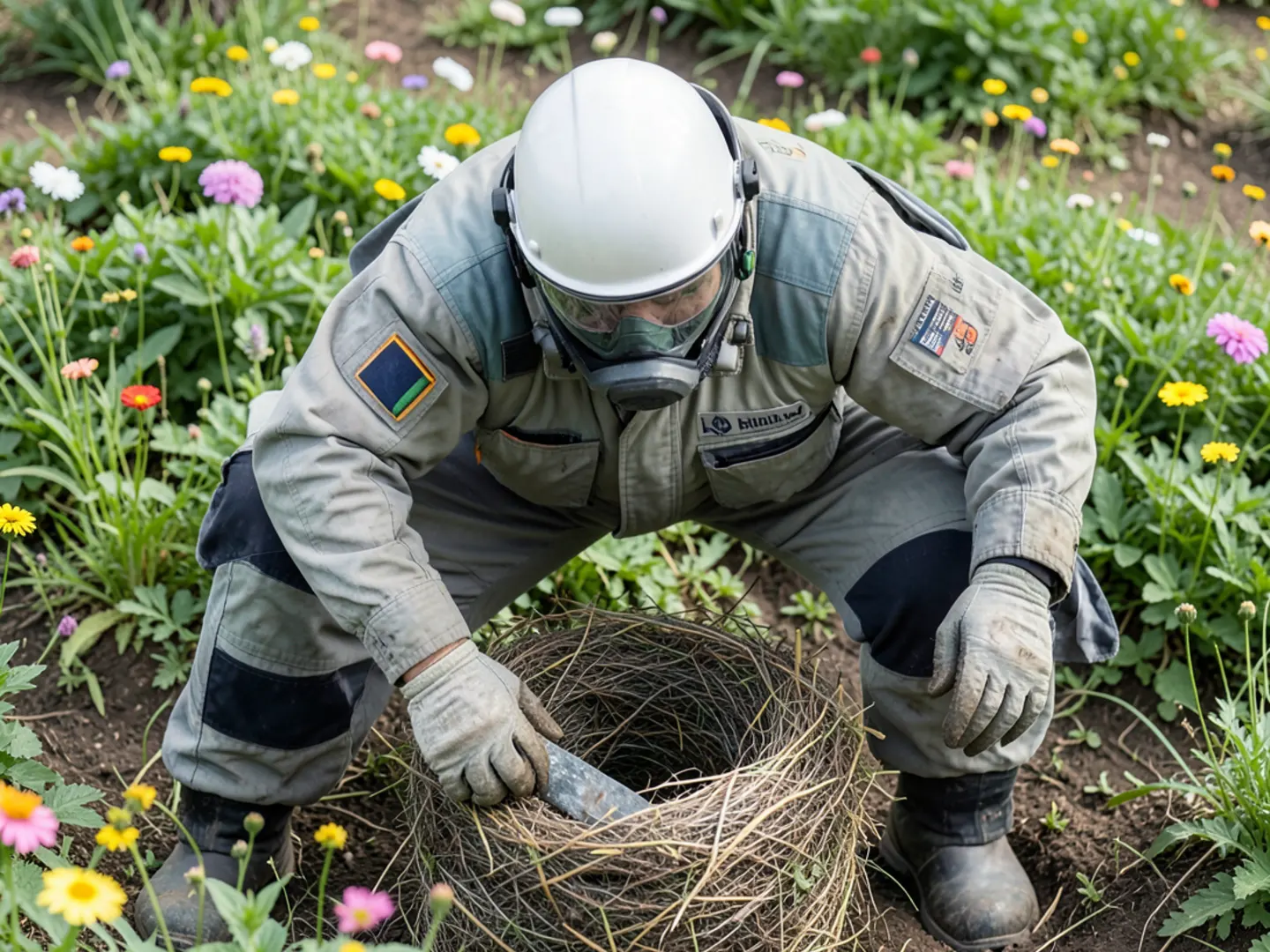
The Professional Eradication Protocol Professional removal of ground yellow jacket nests eliminates the entire colony quickly and safely: - **Commercial Protective Bee Suits:** Certified technicians arrive outfitted in heavy-duty canvas sting suits, full-face wire veils, and sealed leather gauntlets that yellow jacket stingers cannot penetrate. - **Pressurized Underground Dust Injection:** Using specialized mechanical bulb dusters, we inject botanical or synthetic pyrethroid dust directly into the entrance tunnel. - **Colony Transfer Dynamics:** As returning foraging wasps enter the burrow, they walk through the micro-fine dust, tracking it across the underground paper combs and grooming it onto the queen and larvae. - **Complete Knockdown:** The entire colony is completely neutralized within hours, without dangerous swarming or environmental contamination.
Frequently Asked Questions About Ground Yellow Jackets
**Why are yellow jackets so much more aggressive in late summer and fall?** In spring and summer, worker wasps feed on sweet secretions produced by developing larvae. In late summer, the queen stops laying eggs. Deprived of larval sugar, thousands of adult workers forage desperately for nectar, soda, and sweet foods, making them irritable and defensive.
**Will an underground yellow jacket nest survive through the winter?** In Virginia, cold winter freezes kill off all worker wasps and the old queen. Only newly fertilized young queens survive by overwintering under loose tree bark. The old nest decomposes and is never reused the following year.
**How do you tell a yellow jacket from a honeybee?** Yellow jackets have hairless, shiny, bright yellow and black striped bodies and fly with rapid, darting movements. Honeybees are fuzzy, golden-brown or amber, and possess visible pollen baskets on their hind legs.
**Can I mow over a yellow jacket hole at night?** No. Never attempt to run a lawnmower over an active underground nest, even at night. The intense ground vibration triggers immediate defensive attacks, and wasps can swarm up through the mower deck into the operator's clothing.
**How deep is a typical ground yellow jacket nest?** Subterranean yellow jacket nests in Central Virginia clay soils are typically located between 6 and 18 inches below the surface, usually branching off an old rodent tunnel or rotting tree root system.
Discovered an underground yellow jacket nest in your yard? Keep everyone safe and call Sayonara Pest Control at **(321) 496-4080** for same-day emergency removal.
Talk directly with our local Midlothian dispatch team for guidance and fast scheduling.

Related Services & Service Areas
Targeted Services
Local Communities
Need On-Site Pest Assistance in Midlothian?
Call (321) 496-4080 to book a thorough crawl space or perimeter inspection with Sayonara Pest Control.